
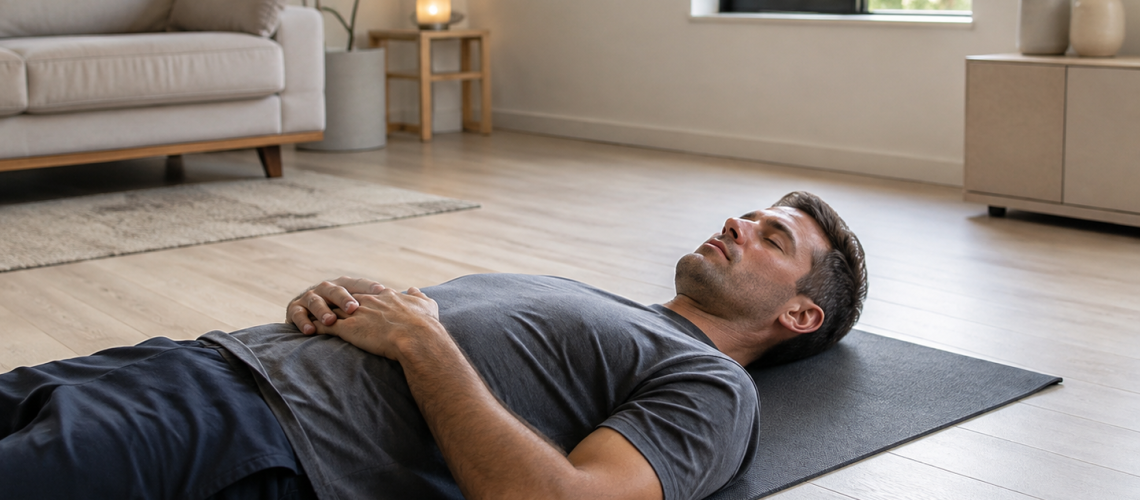
Most people think that to hold their breath longer, they need to spend more time in a pool. Getting comfortable with carbon dioxide, however, is something you can do safely and efficiently right on your sofa.
The urge to breathe is actually caused by the level of CO2 in the blood, rather than a lack of oxygen. When you feel that first strong urge to breathe, it isn’t your body running on empty. It is your brain sounding an alarm because those CO2 levels are rising. By training your body to tolerate higher levels of CO2, you delay that alarm, which translates directly to more comfortable dives.
Doing this on dry land is the smartest approach for a few reasons. First, the risk of a shallow water blackout is completely removed since you are safely lying down. Second, without having to worry about buoyancy, cold water, or other people around you, your nervous system can fully relax.
To get the most out of these sessions, you must actively control your nervous system. You need to shift out of a stressed, sympathetic state and drop entirely into a parasympathetic calm. Controlled exposure to elevated CO2 can actually stimulate this parasympathetic nervous system, promoting relaxation and reducing stress.
Tables are not cardio; they are a controlled, low-heart-rate exposure protocol. If your shoulders are tight, your jaw is clenched, or you are mentally fighting the urge to breathe, you are just burning oxygen and building tension. You have to learn to feel completely relaxed while the CO2 builds up. The goal is to observe the contractions happening in your diaphragm without panicking or reacting to them.
A table is simply a structured series of breath holds with planned rest intervals between them. A CO2 table keeps the hold time fairly steady while reducing rest periods. Because the recovery intervals shrink, your body doesn’t have time to fully clear the CO2 from the previous hold, meaning each round starts with a higher baseline.
Here is how to set up a basic table for your own training. We will assume a target breath hold of 1 minute and 30 seconds, which should be well within your limits and not a maximum effort.
Round 1: Hold 1:30, Rest 2:00
Round 2: Hold 1:30, Rest 1:45
Round 3: Hold 1:30, Rest 1:30
Round 4: Hold 1:30, Rest 1:15
Round 5: Hold 1:30, Rest 1:00
Round 6: Hold 1:30, Rest 0:45
Round 7: Hold 1:30, Rest 0:30
Round 8: Hold 1:30, Rest 0:15
If you want a gentler approach that doesn’t overload your nervous system, you can also try a no-contraction table. This simply involves doing 8 rounds of breath holds where you stop exactly when you feel your first contraction, helping you build mental comfort without creating stress.
While these are dry exercises, you still need to treat them with respect.
Never hyperventilate: Taking fast, deep breaths before a hold strips CO2 from your blood, which defeats the entire purpose of this training and can be dangerous. Breathe normally during the rest periods.
Keep it relaxed: If you are grinding through them or fighting heavy contractions early on, you are pushing too hard. The early rounds should feel relatively easy. The goal is to focus exclusively on developing relaxation while trying to maintain that calm state as the CO2 slowly builds.
Limit your frequency: Doing these tables puts physiological stress on your body. Two to three sessions per week is the sweet spot for most divers. Adaptation happens on your rest days, so make sure you take them seriously.
Get yourself set up on a yoga mat or bed, load up a simple timer on your phone, and start getting comfortable with the uncomfortable.
