
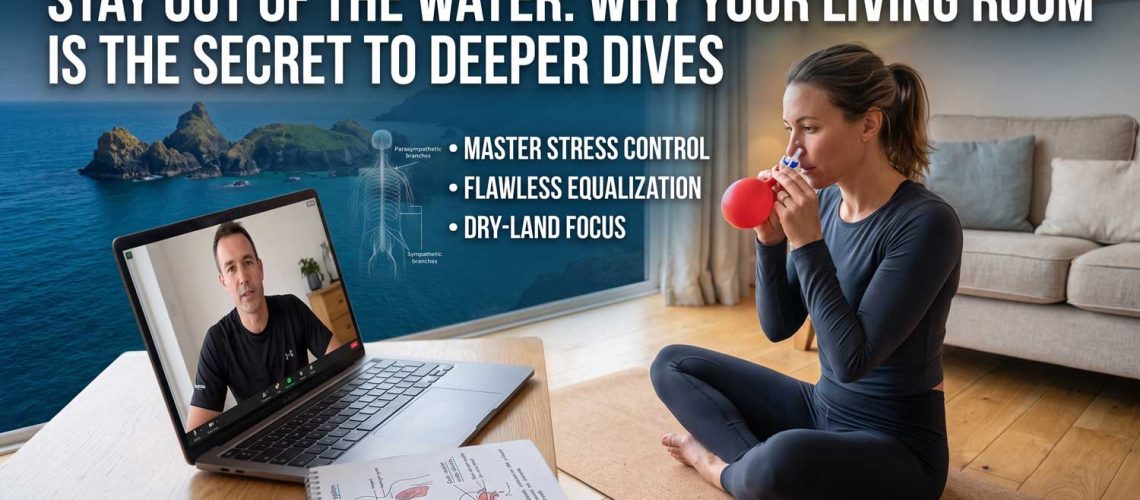
When people think about learning to freedive, they naturally picture the ocean. They picture squeezing into a wetsuit, dealing with weights, and spending hours in the water trying to perfect their breath-hold or equalization. For a long time, that was the only way we taught it. You book a course, you turn up at the beach or the pool, and we figure it out as we go.
Over my fifteen+ years of teaching freediving and working in aquatic risk management, my approach to training has shifted significantly. While water time is entirely necessary for testing your skills, it is actually a terrible place to learn the fundamental mechanics of those skills.
This is why remote, 1-on-1 virtual tuition has become one of the most effective tools I use to build better, safer, and more resilient divers. It might seem counterintuitive to learn a water-based skill through a screen, but when you break down the physiology of freediving, it makes perfect sense.
Here is why taking your training out of the water and into a private, remote environment accelerates your progression faster than forcing it in the ocean.
Water is an incredibly distracting environment. When you get into the sea, your body is instantly processing a massive amount of sensory information. The temperature change triggers a physiological response. The movement of the water requires constant micro-adjustments for balance. You are thinking about your mask leaking, your buoyancy, your buddy, and the depth.
Trying to learn a highly specific, fine-motor skill—like the isolation of your soft palate for the Frenzel equalization technique—while your body is simultaneously dealing with cold water and sensory overload is an uphill battle.
In a group course setting, this is amplified. You are working on a strict timeline, waiting your turn on the buoy, and trying to absorb information while bobbing in the swell. It is fantastic for application, but it is highly inefficient for acquiring complex physiological mechanics.
To understand why dry, remote training works so well, we have to look at the autonomic nervous system. Your nervous system is essentially split into two main branches: the sympathetic (fight-or-flight) and the parasympathetic (rest-and-digest).
Efficient breath-holding and functional breathwork require parasympathetic dominance. You need your heart rate to drop, your muscles to relax, and your mind to quiet down. When you are sitting in your living room looking at a laptop, you are inherently safe. Your body knows it is not in danger. You are warm, comfortable, and grounded.
In this parasympathetic state, your brain is far more receptive to learning new motor patterns. We can strip away the external stressors and focus 100% of your attention on internal awareness. When we work remotely, we isolate the specific muscle groups required for breathing and equalizing. We can spend an hour analyzing exactly how your diaphragm moves, without you having to worry about shivering or staying afloat.
Once you have hardwired those motor patterns in a low-stress environment, they become automatic. When you eventually take those skills into the ocean, your body already knows exactly what to do, even when the sympathetic nervous system starts to ramp up.
A core part of my remote training focuses on functional breathing. Most adults have developed highly dysfunctional breathing patterns over their lifetime. We tend to chest-breathe, using secondary respiratory muscles in our neck and shoulders, rather than fully engaging the diaphragm.
This is a problem for everyday health, but it is a massive roadblock for freediving. Shallow chest breathing signals to the brain that you are under stress, keeping your heart rate elevated and burning through oxygen at a faster rate.
During a 1-on-1 Zoom session, we can carefully break down your breathing mechanics. I can watch your respiratory wave, identify where you are holding tension, and give you immediate, tailored feedback to correct it. We work on nasal efficiency, proper diaphragmatic descent, and extending the exhalation to trigger the vagus nerve, which physically slows your heart rate.
Trying to fix years of dysfunctional breathing while wearing a tight neoprene wetsuit in a swimming pool is incredibly difficult. Doing it in loose clothing on your own floor allows for precise, rapid correction.
One of the biggest misconceptions in freediving is that the urge to breathe comes from a lack of oxygen. It doesn’t. The burning sensation in your lungs, the diaphragm spasms, and the overwhelming desire to take a breath are triggered by a buildup of carbon dioxide (CO_2).
Your body monitors CO_2 levels using specialized sensors called chemoreceptors, located in your brainstem and carotid arteries. When CO_2 rises, these receptors sound the alarm.
Building breath-hold performance is largely about desensitizing these chemoreceptors to higher levels of CO_2. This is called CO_2 tolerance, and it is a metric we can train entirely on dry land. In fact, dry CO_2 tables are safer and often more effective than wet ones because you can push your psychological limits without the inherent risk of a shallow water blackout.
In a remote session, I can guide you through tailored CO_2 protocols. I monitor your contractions, track your recovery times, and adjust the physiological load in real-time. We can map your exact threshold and build a specific dry-training program that guarantees results. When you finally hit the water, the air hunger that used to panic you at 10 meters won’t bother you at all.
If you ask any freediving instructor what halts a diver’s progression most often, the answer is always equalization. Moving from the basic Valsalva maneuver to the Frenzel technique is a mandatory step for diving past 10 meters.
Frenzel equalization is entirely mechanical. It requires closing your vocal folds, sealing your soft palate, and using your tongue as a piston to push air into your Eustachian tubes. It is a precise sequence of muscular contractions happening at the back of your throat.
I have spent countless hours hanging on a buoy trying to explain tongue blocks to frustrated students. It is simply the wrong environment. Remote training has revolutionized how I teach equalization. Using specialized EQ tools, balloons, and webcam feedback, we can visually diagnose exactly what your soft palate and glottis are doing. We can spend an entire hour isolating your tongue muscles until the movement clicks. You get 100% of my attention focused solely on your mechanics, ensuring you have flawless equalization before you ever book a boat trip.
The biggest advantage of private remote tuition is the direct, unfiltered focus. Group courses require a generalized approach to ensure everyone hits a baseline standard safely. Private sessions are built entirely around you.
If your CO_2 tolerance is excellent but your equalization is failing, we don’t waste time on breath-hold tables. We spend the entire session fixing your ears. If your equalization is perfect but you suffer from acute stress or pre-dive anxiety, we dedicate our time to down-regulation protocols and nervous system control.
This level of targeted troubleshooting means you stop wasting time and money on dive trips where you are stuck at the same depth. You put in the hard mechanical work at home, under expert guidance, so that when you travel to the coast or head out into open water, you actually get to enjoy the dive.
You don’t need a pool to become a better freediver. You need clear mechanics, targeted physiological conditioning, and a focused environment to practice them in. That is exactly what remote training delivers.
