
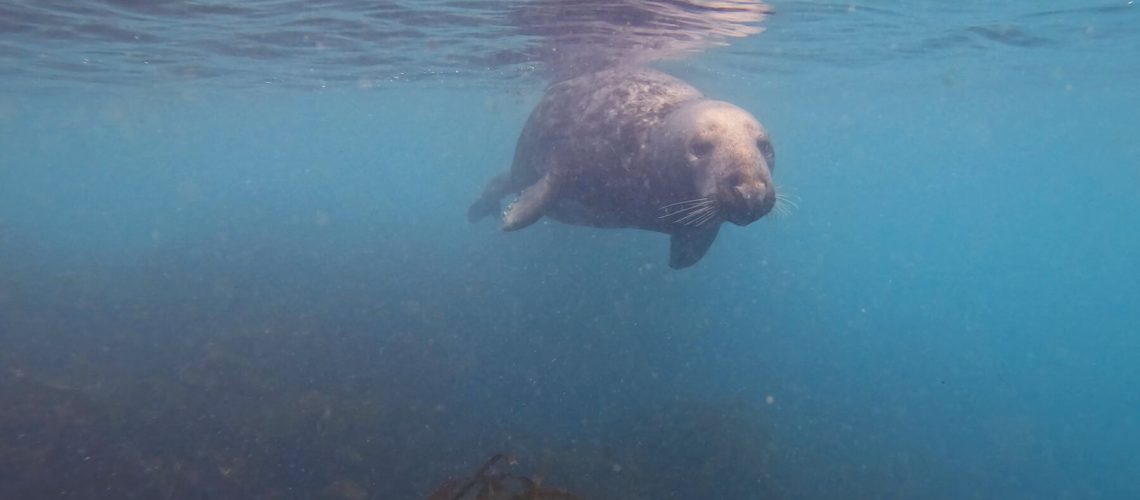
If you like dogs, you’ll love seals.
I’ve always thought grey seals look a bit like underwater Staffordshire Bull Terriers. Big heads, enormous eyes, slightly comical expressions and a seemingly endless curiosity about what you’re doing. And much like dogs, they all seem to have their own personalities. Some are incredibly friendly, others are a bit aloof, and every now and again you meet one that’s just plain grumpy.
I’ve been diving with seals around Cornwall for the best part of twenty years now, and I still get excited every time one comes over to investigate. I’ve had some amazing encounters over the years, from seals playing with me underwater to being rather unceremoniously evicted from a sea cave by a particularly large and unhappy male.
So I thought I’d share a few of those experiences, along with some thoughts on how to behave around seals, what to expect if you encounter them while snorkelling or freediving, and why I think they’re some of the most entertaining animals you can meet underwater.
When we first moved to Cornwall, around 2007 or 2008, one of the first things I did was start exploring the local coastline with my mask and fins.
I’d already been freediving informally for years, although I hadn’t done any formal training at that point. I’d worked as the marketing manager at Ocean Leisure in London, where I’d acquired my first proper freediving fins, and had spent time diving around the world, including Western Australia, where I’d been lucky enough to swim with manta rays, whale sharks and all sorts of other marine life.
So I wasn’t particularly nervous about meeting large animals underwater.
I remember going snorkelling with someone I was working with at the time, just off the southern side of Crantock beach. We were exploring the rocky coastline when a grey seal appeared out of nowhere.
It swam underneath us, turned around, had a good look and then carried on its way.
Nothing particularly dramatic, but it was the first time I’d encountered a seal underwater in Cornwall, and I remember being surprised by how interested it seemed in us.
At that point I didn’t really know much about the local seal population. Little did I know that Polly Joke, with its fairly substantial colony of grey seals, was only a bay away.
Since then I’ve probably spent hundreds of hours in the water around seals, and one thing that has always fascinated me is just how curious they can be.
One of my favourite encounters happened during the early days of FreediveUK, while I was diving around the Gazzle in Newquay with a friend and a couple of Royal Marines.
We were snorkelling along the coastline, chatting away as we went, when I noticed that my friend, who was about twenty metres ahead of us, seemed to be having a conversation with someone.
Which was a bit odd, as the rest of us were behind her.
She was happily chatting away, apparently assuming one of us was swimming alongside her, until she eventually turned her head and realised that her companion was actually a young grey seal.
It had been swimming alongside her, only a couple of metres away, with its head sticking out of the water.
She screamed, the seal disappeared and the rest of us thought it was absolutely hilarious.
Fortunately, the seal wasn’t particularly bothered by the misunderstanding and came back to investigate us again.
It ended up staying around for much of the next hour, and at one point I started diving down towards the seabed with it following me. We’d swim around in circles, looping down through the water, and the seal seemed quite happy to join in.
I picked up a loose piece of seaweed from the bottom and dropped it into the water. The seal swam over, grabbed it and then dropped it underneath me.
So I picked it up again.
And it did exactly the same thing.
We carried on like this for a while, and I can only describe it as playing fetch with a seal.
It was brilliant.
Now, this was many years ago, and it’s worth pointing out that wildlife guidance these days is quite clear about not deliberately encouraging interactions with seals or prolonging encounters. It’s certainly not something I’d suggest people go out and try to recreate.
But it remains one of my favourite experiences underwater. Here was a completely wild animal, apparently choosing to spend its afternoon playing a game with me.
And that, I think, is what makes seals so special.
One of the things I regularly tell students is that if they see a seal, the best thing they can do is pretty much ignore it.
This sounds a bit counterintuitive, especially when you’ve got a camera and are desperate to get some footage, but it works remarkably well.
The problem is that as soon as you start swimming towards a seal, it generally starts swimming away from you.
So you swim a bit closer, and it swims a bit further away.
It’s like trying to push together the opposing poles of two magnets.
I’ve seen this happen countless times, particularly with students using GoPros and other action cameras. The lenses are so wide that a seal which looks enormous in real life appears absolutely tiny on the footage. So naturally they try to get closer to get a decent shot.
And the seal moves away again.
I always joke with students that if they just carry on swimming and appear completely uninterested, they’ll probably turn around to find the seal following them.
And quite often that’s exactly what happens.
Of course, there’s an important distinction between a seal choosing to approach you and you deliberately trying to attract or pursue one. The current guidance is to avoid disturbing seals, give them plenty of room and let them get on with their day.
But I’ve found that the calmer and less interested you appear, the more likely a curious seal is to come over and investigate.
Sometimes they’ll swim alongside you, sometimes they’ll circle around underneath, and sometimes they’ll just hover a few metres away, watching what you’re doing.
And occasionally they’ll come right up to you.
A couple of summers ago I had another lovely encounter at Portmellon, where three very young juvenile seals were hanging around with us in the water.
There was an adult female nearby, but the youngsters seemed completely relaxed and were incredibly inquisitive.
They came right up to us, wrapping their flippers around our legs, resting their heads on our thighs and looking up at us.
They also spent quite a lot of time nibbling our fins.
One of them even gently mouthed my leg through my wetsuit. I moved away slightly and it lost interest. I suspect it was simply investigating what neoprene was.
This is the sort of thing I mean when I compare them to dogs.
They’ll turn their heads to look at you, make eye contact, hover in the water and watch what you’re doing. Some are much more curious than others, and the really inquisitive ones seem to want to investigate absolutely everything.
I’ve been lucky enough to swim with dolphins quite a few times, and I know they’re generally considered the ultimate marine wildlife encounter, but personally I think diving with a friendly, curious seal can be even better.
There’s just something about them.
Perhaps it’s the way their eyes face forwards, or the way they turn their heads to look at you, but they seem remarkably familiar.
It’s almost like you should be able to reach out and give one a scratch behind the ears.
Obviously you shouldn’t! They’re wild animals, not pets, and even a friendly seal has a very impressive set of teeth.
But there’s a little part of your brain that almost expects them to behave like a dog.
I’ve sometimes wondered whether some of the seals around Newquay recognise me. There are a few I’ve encountered regularly enough that I think they might.
I’d love to imagine one spotting me underwater and thinking, ‘Oh, it’s Ian. Let’s go and see what he’s doing.’
Perhaps a bit optimistic, but it sometimes feels like we’re not a million miles away from that sort of relationship.
Of course, not every seal is interested in making friends.
There are some very substantial male grey seals around Newquay, and a few of them have developed a reputation for being rather boisterous.
Some of the seals around the harbour have become accustomed to being fed scraps by fishermen and tourists, which is one of the reasons feeding wild seals is such a bad idea. Once animals start associating people with food, their behaviour can become much less predictable.
I’ve heard plenty of stories about seals grabbing people’s fins or nipping at their feet, and I’ve had a few encounters myself where a seal has made it pretty clear that it wasn’t particularly pleased to see me.
One that sticks in my mind happened when I was swimming into one of the sea caves around Newquay.
I’d entered the cave and found myself facing an enormous male grey seal.
He wasn’t happy.
He came swimming straight towards me, making barking noises, and generally giving me the impression that I wasn’t welcome.
So I turned around and left.
I suspect I’d surprised him in a confined space and he wasn’t particularly comfortable with me being there. Perhaps he felt I was blocking his way out, or perhaps he just didn’t fancy company that afternoon.
Either way, I wasn’t going to argue.
Being effectively chased out of a dark sea cave by a massive male grey seal is a little unnerving, even when you’re fairly comfortable around them.
And it’s a reminder that although seals can be incredibly friendly and inquisitive, they’re still large, powerful wild animals.
They can move astonishingly quickly underwater, and their teeth are designed for catching and holding slippery fish. A bite from a large seal could do some serious damage.
Generally, if you give them space and don’t make them feel threatened, they’re quite happy to get on with their own business.
But if you surprise one, corner it or get between it and somewhere it wants to go, you may get a rather less welcoming response.
Caves are particularly worth being careful around. You never quite know what’s resting inside, and confined spaces don’t give either of you much room to get out of the way.
I remember another encounter while swimming through the tunnel underneath St Anthony’s Head.
I was swimming along with my head down, concentrating on my position in the water, when I managed to almost headbutt a seal.
I hadn’t seen it, and apparently it hadn’t seen me either.
We both looked up at each other in surprise, then went our separate ways.
I didn’t see it again that afternoon.
Probably just as well. I suspect neither of us was particularly impressed with the other’s underwater awareness.
This is something I’ve become quite good at recognising over the years, although there’s obviously no universal seal language that tells you exactly what they’re thinking.
A relaxed, curious seal will often swim past slowly, turn to look at you and perhaps make a few passes to see what you’re doing.
But if they start moving very quickly, changing direction suddenly or appearing panicked, then something isn’t right.
Likewise, if they’re making a lot of noise, splashing around or behaving defensively, it’s probably time to give them some space.
Sometimes it’s even simpler than that. They’ll just swim away and carry on with whatever they were doing.
Quite often that’s fishing.
And that’s fair enough really. They’re not there for our entertainment. They’ve got things to do, food to catch and places to go.
The best encounters are always the ones where the seal seems completely relaxed and is choosing to spend time investigating you.
If that changes, it’s time to leave it alone.
We’re pretty lucky in Cornwall because grey seals are found all around the coastline, although some areas are obviously much more popular with them than others.
They tend to favour places where they can haul out of the water relatively easily, particularly sheltered coves, beaches and exposed rocks where they can rest without being constantly battered by the Atlantic swell.
Some of these places are substantial colonies, while others are just little rocks that appear as the tide drops.
There’s one particular rock around Newquay that’s barely big enough for two seals. I’ve watched them position themselves on it as the tide falls, effectively letting the water drain away until they’re sitting high and dry.
They’ll then rest there until the tide comes back in, when they can simply slip back into the water and carry on fishing.
Quite an efficient arrangement really.
Polly Joke is probably one of the better-known seal areas around Newquay, and there’s often a substantial number of seals resting around the little beaches and coves there.
I recently made a video diving around the Chick, just off Polly Joke, and deliberately chose to stay away from the main haul-out beach.
The last thing I wanted was to approach a group of resting seals and cause them all to rush into the water.
And this is probably one of the most important things to understand about seal encounters.
A seal choosing to approach you in the water is very different from you approaching a seal that’s resting on a beach or rock.
When seals are hauled out, they’re there for a reason. They need to rest, conserve energy and, at certain times of year, care for their pups.
Disturbing them can cause them to abandon their resting place and rush into the sea, which can be particularly harmful to young animals.
The recommended approach is to stay well away from haul-out sites, generally at least 100 metres, and never deliberately approach resting seals or try to encourage them into the water.
Of course, one thing worth remembering is that the seals haven’t actually read any of this guidance.
And quite often, they’re the ones breaking all the rules.
You can be minding your own business, keeping your distance and doing absolutely everything you’re supposed to, only to have a curious seal appear alongside you and decide it’s going to spend the next few minutes investigating your fins.
I certainly don’t think you need to panic and immediately get out of the water because a seal has chosen to come over and say hello.
There’s a big difference between deliberately approaching or pursuing a seal and having one approach you while you’re going about your own dive. The important thing is to recognise that difference, remain relaxed, avoid encouraging physical contact and be prepared to give the animal space if its behaviour changes.
Ultimately, you can’t control what a wild seal decides to do. You can only control how you respond to it.
The same goes for mothers and pups. Give them plenty of space and don’t do anything that might separate them or interrupt feeding.
There’s no shortage of coastline to explore without interfering with animals that are simply trying to have a rest.
Not necessarily.
I’ve seen scuba divers have some fantastic encounters with seals, and I don’t think freediving offers any particular advantage over scuba in that respect.
Seals are curious animals, and they’ll often investigate scuba divers just as readily as freedivers.
Where freediving does make a difference is compared with staying entirely on the surface.
When you’re snorkelling, seals will often keep a little more distance. But once you dive underwater, they sometimes become much more inquisitive.
Their underwater senses are considerably more developed than ours, and they’ll certainly be aware that you’ve descended.
I’ve had plenty of encounters where I’ve made a relaxed dive down to five or ten metres, settled briefly in the water and watched seals come over to investigate.
They’ll sometimes swim around you, make a few passes and come much closer than they would if you were simply floating on the surface.
Perhaps they feel less threatened when you’re underwater with them, or perhaps they’re simply curious about something unusual moving around in their environment. I don’t really know.
But it certainly seems to make a difference.
Of course, you should never push your freediving limits in an attempt to get closer to wildlife. Dive within your training and ability, always with a competent buddy, and never extend a breath-hold just because a seal has decided to come over.
And if you’re simply snorkelling, don’t feel that you’re missing out.
Sometimes just seeing a seal swimming past underwater is enough to make the whole dive worthwhile.
I don’t see anything inherently wrong with wanting to get in the water and experience swimming with seals.
After all, I’ve spent a considerable amount of my life doing exactly that.
But I think it’s important to approach it with the right attitude.
It’s a wildlife encounter, not an organised performance.
You might spend an entire afternoon in the water and see nothing. You might see a seal twenty metres away that never comes any closer. Or you might get lucky and have a particularly curious animal come over and investigate.
The important thing is to be happy with whatever happens.
Don’t chase them, don’t try to touch them, don’t feed them and don’t interfere with what they’re doing.
If you encounter seals while diving, remain calm, keep your movements relaxed and predictable, and let them decide whether they want to stay around.
Keep encounters brief and move away if you see any signs of disturbance.
And don’t forget that getting into the water specifically to approach seals, particularly around resting or breeding areas, can cause problems before you’ve even seen an animal underwater.
Sometimes the best decision is simply to watch from a distance.
For me, one of the nicest things about seeing a seal underwater is that you’re sharing its environment.
It’s very different from watching one from a boat or standing on a cliff looking down at it.
Even if it’s twenty metres away and never comes any closer, you’re both in the same world for a little while.
And that can be a wonderful experience in itself.
Not for me.
I think when I’m teaching, I probably experience seal encounters a little differently from when I’m diving for myself.
I’m watching the students, keeping an eye on how they’re behaving, monitoring the seals and generally making sure everything is going smoothly.
It’s part of being an instructor. You can’t entirely switch off that sense of responsibility when you’ve got people in the water with you.
But when I’m diving with a buddy, without having to think about anyone else’s training or safety beyond our normal buddy responsibilities, I can enjoy the experience in a completely different way.
And I still get that same feeling of excitement whenever a seal comes over.
Especially when you get one that’s properly interested.
One that swims past, turns around, comes back and decides to hang around for a while.
Because ultimately, that’s what I find so special about them.
They’re completely wild animals. They don’t need us, they’re not waiting for us and they’ve got absolutely no obligation to interact with us.
But occasionally, for whatever reason, one will decide that whatever it was doing can wait.
It’s going to spend a little time with you instead.
And I don’t think that will ever stop feeling special.
Ian Donald has been teaching freediving in Cornwall since 2009 and runs FreediveUK, specialising in private freediving training and technical coaching.
