
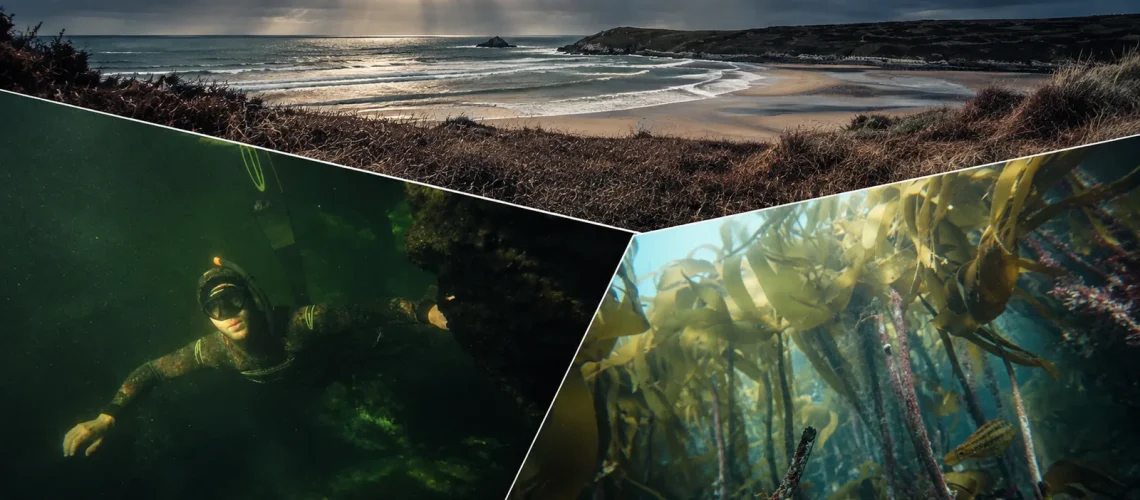
Cornwall in winter is a very different place to the Cornwall most visitors know. The beaches are quiet, the roads are empty, and the landscape has a slightly wilder feel to it. The Atlantic can be pretty unforgiving at this time of year, but between the storms there are some wonderful days, with clear water, crisp air and hardly another soul around.
I’ve always enjoyed this quieter side of Cornwall, particularly the contrast between the exposed granite landscape of Bodmin Moor and the sheltered coves tucked away along the coast. They’re two very different environments, but both offer something special when you get into the water.
That’s the idea behind From the Moor to the Sea, a private, guided wild-water experience that takes us from a flooded granite quarry on Bodmin Moor to the underwater reefs of the Cornish coast. It’s a day of cold-water immersion, exploring, snorkelling and, for those who want to, freediving. But it’s also about the journey between the two, getting away from the usual tourist spots and seeing a different side of Cornwall.
We’ll start the morning at Delphy Pool, a beautiful old granite quarry hidden away on Bodmin Moor. It’s a place I know extremely well, having spent countless hours in its water over the years. Surrounded by granite and open moorland, it has a wonderful stillness about it, particularly during winter.
Our first activity is an introduction to cold-water immersion. This is optional, of course, but it’s very much part of what I’ve designed the day around, and I’d encourage anyone who’s curious to give it a try.
Cold water has an immediate and quite extraordinary effect on the body. As you enter, cold receptors in the skin trigger a rapid response from the nervous system. Your breathing wants to speed up, your heart rate and blood pressure rise, and your body becomes suddenly, intensely alert. It’s the familiar cold-shock response, and even when you’re expecting it, the sensation can be quite remarkable.
What’s interesting is what happens as you settle into it. With a controlled, gradual entry and a little time to adjust, the initial shock can begin to subside. Your breathing becomes easier to manage, the urge to get straight back out becomes less insistent, and you start to feel more comfortable in an environment that seemed distinctly uninviting just a few moments earlier.
There’s something rather satisfying about that transition. You’re not fighting the cold or trying to prove how tough you are. You’re simply allowing your body to respond, becoming familiar with the sensations and discovering that you can remain reasonably calm despite them.
And afterwards? Many people describe a wonderful sense of alertness, energy and improved mood. Part of that is the body’s stress response, and part of it may simply be the satisfaction of having done something that initially felt uncomfortable. Either way, stepping back out into the fresh moorland air can feel surprisingly invigorating.
We’re not aiming for long immersion times. In fact, quite the opposite. The intention is to experience the initial cold-water response and begin to settle into it, without remaining immersed long enough to produce a substantial drop in core body temperature. How long that takes varies enormously between individuals and conditions, so we’ll keep things brief, sensible and within appropriate safety limits.
We’ll enter gradually, keep our heads above water and concentrate on comfortable breathing rather than breath-holding. If cold immersion isn’t appropriate for you, or you simply don’t fancy it, there’s no pressure to take part.
Afterwards, we’ll dry off, get warm and prepare for the next part of the adventure.
If you’re new to freediving, we’ll also spend some time going through the fundamentals before we head off to the coast. Nothing too formal, just a relaxed theory session where I’ll explain how freediving works, the importance of breathing and relaxation, how to equalise your ears, and the basic safety principles we’ll use when we’re in the sea. We’ll also talk about what to expect underwater and answer any questions you might have.
It means that by the time we arrive at the coast, you’ll already have a good understanding of what we’re going to do and why.
From the quarry, we’ll jump in the car and make our way towards the coast.
This is one of my favourite parts of the day, and it’s deliberately unhurried. We’ll bimble down the narrow Cornish lanes, past old stone walls, farms and little villages, heading for whichever stretch of coastline is looking most promising.
I won’t necessarily know our exact destination until the day itself. Cornwall’s coastline is incredibly varied, and with the Atlantic swell, wind direction and tides all influencing the conditions, choosing the right location is an important part of the experience.
Sometimes a cove that was perfectly sheltered yesterday will be completely unsuitable today, while somewhere just around the headland might offer lovely calm water. Having spent so many years exploring these places, I have a good selection of locations to choose from, and I’d much rather take you somewhere that suits the conditions than insist on visiting a particular beach simply because it was written on an itinerary.
There’s no convoy, no large group and no complicated schedule. Just us, the car and a few Cornish lanes, with the chance to chat about the landscape, the sea and whatever else comes up along the way.
Once we’ve reached the coast, we’ll get changed into our wetsuits and prepare to explore.
Unlike our brief cold-water immersion at the quarry, this part of the day is about spending a little longer in the water, so we’ll be properly equipped with warm wetsuits, hoods, gloves and the other equipment we need.
For anyone who’s only seen Cornwall’s coastline from above the surface, there’s an extraordinary amount waiting underneath. Rocky gullies, kelp forests, boulder fields and reefs provide habitats for all sorts of marine life. Wrasse, crabs, anemones, starfish and countless smaller creatures are all part of this underwater landscape, and every location has its own character.
One of the things I particularly enjoy is showing people how much they can discover simply by slowing down and looking carefully. You don’t need to dive to great depths to see something interesting. Often, the most fascinating things are hiding among the rocks in just a metre or two of water.
We’ll explore at a pace that suits you, stopping to investigate whatever catches our attention. If you’re new to snorkelling or freediving, I’ll help you become comfortable in the water and put some of the fundamentals we discussed earlier into practice. If you’ve already got some freediving experience, we can incorporate some breath-hold dives where the conditions and your ability allow. But there are no depth targets or performance requirements. The point is to enjoy the environment, not to turn the afternoon into a training session.
It’s worth remembering that the sea takes a while to cool down after summer. Before Christmas, we can sometimes enjoy surprisingly comfortable conditions in a good wetsuit, but by January and February the water is generally approaching its coldest. Even with warm equipment, our time in the water will usually be shorter, and we’ll plan the dives accordingly.
That doesn’t make it any less enjoyable. There’s something wonderfully exhilarating about slipping beneath the surface on a crisp winter day, particularly when the water is clear and you’ve got an entire cove to yourself. We just need to be realistic about how long we’ll stay in.
And of course, we’re working with the Atlantic in winter. If the conditions aren’t suitable, we won’t force it. I’ll assess the forecast beforehand and the actual conditions on the day, and we’ll adapt our plans accordingly.
Eventually, we’ll make our way back to shore, get changed into warm clothes and have a well-earned hot drink.
There’s something particularly enjoyable about standing beside a quiet Cornish cove with a steaming mug in your hands after a winter swim. The contrast between the cold water and the warmth afterwards is part of the pleasure, and it’s a lovely opportunity to talk about what we’ve seen.
Then it’s back into the car for the journey home, hopefully with a few stories to tell and a slightly different appreciation of Cornwall.
I’ve designed From the Moor to the Sea for individuals or pairs who want to experience Cornwall in a way that’s a little different from the usual coastal walk or organised activity.
You don’t need to be a qualified freediver, and you don’t need any previous experience of cold-water immersion. You should be a competent swimmer and reasonably comfortable with the idea of entering open water, but we’ll discuss your experience beforehand and adapt the day accordingly. If you’ve never freedived before, I’ll introduce you to the fundamentals during our morning theory session, so you’ll have some basic knowledge and an understanding of the safety principles before we reach the coast. Any breath-hold diving will be supervised and matched to your ability.
It’s equally suitable for someone who’s already comfortable in the sea and would enjoy exploring a few of my favourite places along the coast. The advantage of keeping it private is that we can make the day our own.
The experience is available throughout the year, although I think it has a particular appeal between October and March, when Cornwall is quieter and the landscape feels at its wildest.
The price is £450 for one person or £500 for two people booking together, including the equipment needed for the water activities.
I suppose what appeals to me most about this experience is its simplicity. We start the day on a remote stretch of Bodmin Moor, experience the extraordinary sensation of cold water against our skin, then wind our way down towards the Atlantic to explore a completely different underwater environment.
There’ll be some learning along the way, of course, but there’s no syllabus to follow and no particular achievement we’re working towards. It’s simply a chance to spend a day discovering a few of the places and experiences that make Cornwall special to me.
And if we happen to find a particularly lovely sheltered cove, some clear winter water and a few curious fish along the way, so much the better.
You can find more information and enquire about arranging your own day on the From the Moor to the Sea experience page.
