
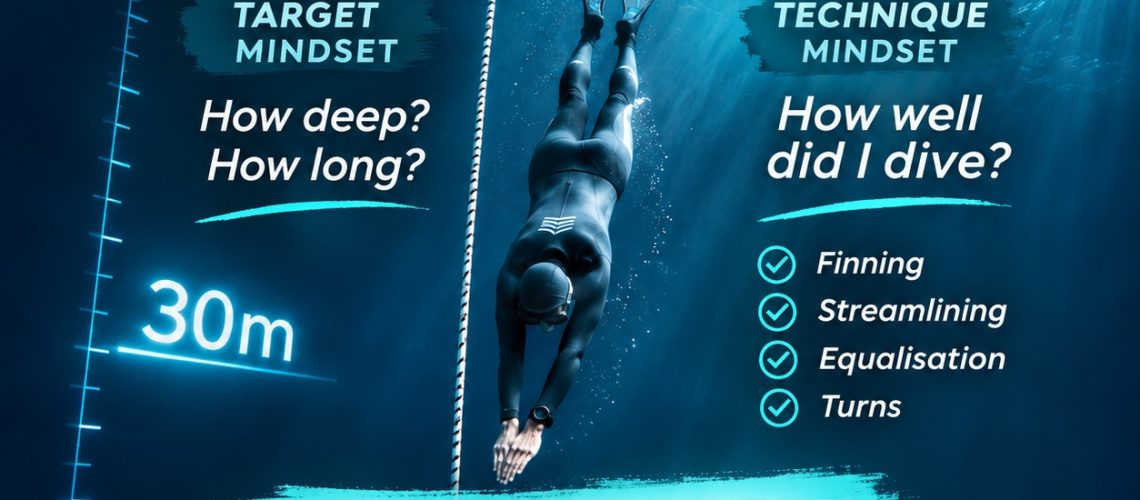
Target Fixation vs Technique Fixation: Give Yourself Some Style Points
There’s a question that freedivers seem almost incapable of resisting when they meet another freediver.
How deep can you go?
Sometimes it’s how long you can hold your breath, or how far you can swim underwater, but the principle is much the same. We want a number.
And, if we’re being fair, it’s a perfectly reasonable question. Depth, distance and time are measurable, easy to compare and give us something tangible to work towards. They’re also rather fundamental to the sport of freediving.
The problem is that somewhere along the way, we’ve started confusing those numbers with how good somebody actually is at freediving.
I’ve been teaching freediving since 2009, and one of the things I’ve noticed over the years is just how much influence a particular number can have over someone’s perception of their own ability. I’ve seen divers make enormous improvements in their technique, become more comfortable and more efficient in the water, and still finish the day feeling disappointed because they haven’t reached the depth they’d set their heart on.
Equally, someone can reach a new personal best, having made a complete dog’s dinner of the dive, and come out of the water feeling like they’ve conquered the world.
It’s an interesting contradiction, and one that I think we could do with addressing.
Freediving Doesn’t Have Style Points
Unlike gymnastics, figure skating or competitive diving, freediving doesn’t award points for style.
Nobody’s standing at the surface holding up a little card with a 9.5 on it because you’ve just performed a particularly beautiful duck dive.
In competitive freediving, assuming you’ve completed a valid performance, the result is measured in metres or seconds. There are rules governing how the dive must be completed, of course, but there’s no additional reward for beautiful finning, excellent streamlining or an exceptionally well-executed turn.
And that’s fine. Competition needs objective measurements, and depth, distance and time provide them.
But most freedivers aren’t competing.
They’re diving because they enjoy it, because they want to improve, because they love being underwater, or perhaps because they simply want to see what they’re capable of.
Yet we’ve largely adopted the same numerical measures of success.
We celebrate the 30-metre dive rather than the beautifully executed 20-metre dive. We congratulate the person who has added another 30 seconds to their static breath-hold, but rarely the person who’s finally mastered a technical problem they’ve been struggling with for months.
And gradually, we begin to believe that unless the numbers are improving, we’re not improving.
Which simply isn’t true.
The Problem with Target Fixation
Let’s imagine a freediver whose personal best is 30 metres.
They arrive at a training session determined to reach 32 metres. Perhaps they’ve been trying to get there for several weeks, and every time they get into the water, that number is sitting somewhere in the back of their mind.
They make a dive to 25 metres.
Their equalisation is good, their finning is efficient, they’re relaxed, comfortable and in control. It’s an excellent dive.
But it’s not 32 metres.
So they come back to the surface disappointed.
Perhaps they try again, pushing a little harder this time. They start anticipating the point at which they normally turn, become increasingly conscious of their depth and begin concentrating more on getting down the line than on the quality of the dive itself.
Now, I’m not suggesting that every diver behaves like this, or that setting a depth target automatically creates problems. But I’ve seen enough variations of this scenario over the years to recognise how easily it happens.
The target becomes the measure of success, and everything else becomes secondary.
Worse still, repeatedly failing to reach that target can begin to affect how someone thinks about their diving.
They start telling themselves they’re having a bad day, that they’re not progressing, or perhaps that they’re simply not very good at freediving.
All because of a number.
And the frustrating thing is that they might actually be becoming a considerably better diver throughout the process.
Technique Fixation: Changing What Success Looks Like
One of the things I regularly do when coaching someone who’s become particularly focused on a depth or breath-hold target is to take that target out of the equation.
Not necessarily by telling them they can’t go to a particular depth, but by giving them something else to concentrate on.
Perhaps their finning needs attention. Maybe their body position could be better, their duck dive is inefficient or their equalisation technique needs refining.
Whatever it is, we choose one aspect of their technique and make that the objective.
For that dive, I don’t particularly care whether they reach 15 metres, 20 metres or 25 metres. What I’m interested in is whether they’ve improved the technical element we’re working on.
And I want them to be interested in that too.
Rather than coming back to the surface and immediately asking how deep they went, I want them thinking about how well they performed the dive.
Did their finning feel more efficient? Were they able to maintain a better body position? Did they correct something they’d been doing badly for years?
If they did, that’s progress.
And here’s the interesting bit.
Quite often, once somebody stops concentrating on reaching a particular depth and starts concentrating on how they’re diving, they end up reaching that depth anyway.
It isn’t magic. They’re simply directing their attention towards things that can make the dive more efficient and controlled, rather than becoming preoccupied with the result.
But there’s an important distinction here.
The purpose of improving technique isn’t simply to trick yourself into reaching greater depths.
If the diver doesn’t reach their target but makes a genuine technical improvement, that’s still a successful training session.
In fact, I’d argue it’s often a more productive one.
One Thing at a Time
Of course, there’s a potential problem with telling somebody to concentrate on their technique.
A freedive involves quite a lot of different things happening, and the last thing I want is someone descending the line mentally running through a shopping list of everything they think they should be doing.
Keep my head down. Relax my shoulders. Straighten my legs. Point my toes. Equalise. Don’t forget to relax. Am I relaxed?
That’s hardly a recipe for a comfortable dive.
Instead, I prefer to give someone one specific thing to work on.
If we’re concentrating on finning, then that’s the focus. We might spend several dives refining the movement, making small adjustments and seeing what works.
The other aspects of their diving don’t suddenly become irrelevant, but we’re not trying to consciously correct everything at once.
And we don’t necessarily expect to perfect that skill in a single session.
They might return the following week and work on their finning again. Perhaps they make another small improvement. Perhaps something that felt awkward last time suddenly begins to feel more natural.
That’s another successful day.
Over time, the objective is for those improvements to become part of how they normally dive, rather than something they have to consciously think about every time.
Building the House
There’s another important part of this approach.
Just because we’re working on one technical element at a time doesn’t mean we need to keep hammering away at the same thing until it’s perfect.
Sometimes a particular technique simply isn’t coming together.
You can spend an entire session trying to refine your finning, for example, and reach a point where you’re no longer making useful progress. You’re becoming frustrated, you’re overthinking it, and whatever improvement you made earlier seems to be disappearing.
At that point, I’d rather move on.
Work on your duck dive. Spend some time refining your streamlining. Concentrate on your turn, or another aspect of your diving that could benefit from attention.
Then come back to the finning another day.
I tend to think of it as building a house.
You don’t have to finish one room completely before you’re allowed to start work on another. There are foundations to establish, different elements to develop and plenty of things that need to come together before the whole structure works properly.
Freediving technique is much the same.
Your body position affects your finning. Your relaxation influences your equalisation. Your duck dive sets you up for the descent that follows.
These things aren’t entirely separate, and improving one can sometimes help another.
By rotating through different technical objectives over a series of training sessions, you’re gradually building a more complete diver.
And importantly, you’re giving yourself plenty of opportunities to recognise progress along the way.
Start Giving Yourself Style Points
Which brings me back to the problem with freediving not having style points.
Perhaps we should start awarding ourselves some.
It’s something I try to encourage my students to do.
Before a dive, decide what you’re going to work on. Choose something specific and achievable, whether that’s improving your finning, refining your turn or maintaining a more efficient position in the water.
Then, when you return to the surface, judge the dive on that basis.
Not by how deep you went, but by how well you performed the skill you were concentrating on.
Give yourself some personal style points.
Did you do it better than last time? Was the movement more controlled? Did you manage to correct a bad habit? Are you becoming more consistent?
Those are all worthwhile achievements.
And if it wasn’t quite right, you’ve still learnt something. Perhaps you need to approach it differently next time, or perhaps it’s worth putting that particular skill aside for a session and working on something else.
The point is that you’ve given your training a purpose beyond simply finding out what you’re capable of on that particular day.
You’re developing your diving rather than constantly testing it.
And I think that distinction matters enormously.
What About Personal Bests?
I should probably make something clear at this point.
I’ve got absolutely nothing against personal bests.
There’s a great deal of satisfaction in achieving a depth or breath-hold time that you’ve been working towards. Targets can be motivating, and numerical measurements are useful for tracking progress.
I’m certainly not suggesting that everyone should stop recording their dives or pretend that depth doesn’t matter.
But I do think we need to be a little more careful about the importance we attach to those numbers.
A personal best tells you what you managed to achieve on a particular day, under a particular set of circumstances.
It doesn’t necessarily tell you how well you performed the dive, how consistently you could repeat it or how technically competent you’ve become.
And just because you reached 30 metres last month doesn’t mean every subsequent dive to 25 metres represents some sort of failure.
Conditions change. Your physical and mental state changes. Training objectives change.
There are plenty of perfectly good reasons why you might not match your previous performance.
But if your technique is improving, you’re becoming more efficient and you’re developing greater control over your diving, then you’re moving in the right direction.
The numbers may well follow.
And if they don’t, you’ve still become a better diver.
So, What Makes a Good Freedive?
For me, a good freedive isn’t necessarily the deepest or longest one.
It’s a dive that achieves what you set out to work on, performed comfortably, with control and appropriate attention to safety.
Sometimes that might involve reaching a particular depth. Sometimes it might mean making a tiny improvement to a technical skill you’ve been struggling with for weeks.
And sometimes it might simply mean recognising that something isn’t working particularly well today and deciding to concentrate on something else.
The important thing is not to allow a number to dictate whether you consider yourself successful.
If you’re continually judging your diving against your personal best, there’s a good chance you’ll spend an awful lot of perfectly productive training sessions feeling disappointed.
But if you start paying attention to the quality of your diving, you’ll begin to notice improvements that might otherwise have gone completely unrecognised.
So next time you finish a training session, rather than immediately asking yourself how deep you went or how long you held your breath, try asking a different question.
What did I do better today?
And if you’ve improved something, however small, give yourself a few style points.
You might find you’re a better freediver than your dive computer has been telling you.
—
Ian Donald has been teaching freediving in Cornwall since 2009 and runs FreediveUK, specialising in private freediving training and technical coaching.
